


Pet Travel From the United States to the Philippines
Travel Requirements Based on Pet Type
Carefully read ALL of the requirements related to your pet on this page.
- This page provides the most recent entry requirements and can change without notice.
- It is the responsibility of the veterinarian to make sure the pet has met all health requirements of the destination country before issuing a health certificate.
- Failure to meet the requirements may result in problems gaining certificate endorsement or difficulties upon arrival in the destination country.
- Health certificates must be legible, accurate, and complete.
Philippines Requirements Memo (2.74 MB)
A summary of the requirements are as follows;
- Pet dogs and cats must first obtain an import permit from the Philippine Bureau of Animal Industry (BAI).
- You may apply for an import permit (known by the acronym “SPSIC”) from the BAI
A Users Guide for the registration process (1.87 MB)
- For personal pets, please select “one-time importer” when applying for your SPSIC via the above website.
- Up to three animals total (dogs or cats, or combination thereof) can be listed on one SPSIC.
- The SPSIC will specify the animal health import requirements for the pet dogs and/or cats that must be met prior to travel to the Philippines.
- If your animal’s SPSIC is issued for one animal, then the corresponding export health certificate may be issued for ONLY that one animal. However, if your animals’ SPSIC is issued for two or three animals, the corresponding export health certificate may be issued for the same two or three animals that are listed on the SPSIC. The number of animals listed on the SPSIC must match the number of animals listed on the health certificate.
- All health certificates for pet dogs and cats to the Philippines must be issued by a USDA accredited veterinarian, and then endorsed by USDA-APHIS prior to travel.
- Your private USDA accredited veterinarian will then issue an export health certificate in accordance with the criteria listed in the SPSIC.
- The USDA accredited veterinarian can either upload the completed fillable PDF health certificate and submit the form electronically to APHIS for endorsement through the Veterinary Export Health Certification System (VEHCS), or can complete the entire process including issuance and endorsement via VEHCS.
International Health Certificate (192.28 KB)
Philippines Requirements Memo (2.74 MB)
A summary of the requirements are as follows;
- Commercial U.S. exporters of dogs and cats should first ensure that their Philippine importer is registered with the Philippine Bureau of Animal Industry (BAI) and approved by BAI to import commercial shipments of pet dogs and cats. If the Philippine importer is not registered with BAI, he/she can apply to be registered.
A Users Guide for the registration process (1.88 MB)
- The registered Philippine importer will obtain the required Philippine import permit (known by the acronym “SPSIC”) from BAI and provide a copy of the SPSIC to the U.S. exporter. There are no BAI restrictions on the number of dogs and/or cats that can be listed on a commercial SPSIC.
- The SPSIC will specify the animal health import requirements for the commercial U.S. origin dogs and/or cats that must be met prior to travel to the Philippines.
- The corresponding export health certificate can only list the same number animals that are identified on the SPSIC. The number of animals listed on the SPSIC should match the number of animals listed on the APHIS export health certificate.
- All health certificates for commercial U.S. origin dogs and cats to the Philippines must be issued by a USDA accredited veterinarian, and then endorsed by USDA-APHIS prior to travel.
- Your private USDA accredited veterinarian will then issue an export health certificate in accordance with the criteria listed in the SPSIC.
- The USDA accredited veterinarian can either upload the completed fillable PDF health certificate and submit the form electronically to APHIS for endorsement through the Veterinary Export Health Certification System (VEHCS), or can complete the entire process including issuance and endorsement via VEHCS.
International Health Certificate (192.28 KB)
Note: The Philippines does not permit entry of U.S. origin birds or poultry from ANY county with confirmed HPAI detections in poultry, as defined by WOAH. Should three or more counties in one State have confirmed cases of HPAI, expect that entire State to become restricted as well.
There are currently STATE-level restrictions on all domestic and wild birds and their products, including poultry, day-old chicks and hatching eggs from the following U.S. states, due to HPAI: California, Maryland, Missouri and South Dakota.
- Birds – Pet, Exhibition, Day-Old Chicks, Hatching Eggs - Health Certificate (191.95 KB) - February 2019
Note: Shipments of adult birds, including game fowl, must have proper identification on each bird that is consistent with the identification on the health certificate. Additionally, if an import permit is issued/presented with different requirements than those in the posted model health certificate above, the import permit may be used to create an alternative health certificate to meet those stated requirements.
For pet travel requirements not listed, APHIS has not been officially informed by the foreign country about the requirements for your pet’s travel. We recommend that you contact a government official of the country you are traveling to for more information.
Country of Destination Contact Information
For more information on how to obtain an import permit please contact:
Bureau of Animal Industry
National Veterinary Quarantine Service
Visayas Ave., Diliman, Quezon City 1128
Tel. No. 011 (632) 920 0816/926 4343
Fax No. 011 (632) 920 0815
E-mail: bai_dir@yahoo.com; baiquarantineph@gmail.com; baiquarantine@hotmail.com
Countries Participating in the European Union
Austria
Belgium
Bulgaria
Croatia
Cyprus
Czech Republic
Denmark
Estonia
Finland
France
Germany
Greece
Hungary
Republic of Ireland
Italy
Latvia
Lithuania
Luxembourg
Malta
Netherlands
Northern Ireland*
Norway**
Poland
Portugal
Romania
Slovakia
Slovenia
Spain
Sweden
Switzerland**
* Northern Ireland is part of the United Kingdom (UK), but will continue to follow European Union (EU) requirements even though the UK is no longer part of the EU.
** Norway and Switzerland are not part of the EU but have adopted EU legislation for import of most species of live animals.
Important Travel Considerations
Considerations for airline travel and cruises:
Airlines and shipping lines have their own policies and requirements for transporting pets. Check with your airline or shipping representative to determine what requirements they may have.
Learn how you can improve the safety of dogs and cats during air travel.
If pets or support animals accompany you on a cruise, you must comply with entry rules for every country or port where your pet or support animal exits the ship.
Will you be returning to the United States with your pet?
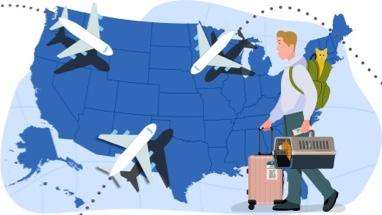
View APHIS Requirements
ALERT: If you're traveling with a dog, be aware that the CDC has additional requirements for bringing a dog into the United States. You must follow CDC's requirements, or your dog will not be allowed to enter the United States.
If you are transiting (passing through) the European Union:

If your pet is traveling through (transiting) a country in the European Union (EU) on the way to a third, non-EU country, you will also need a transit health certificate for your pet for the EU. The transit health certificate will be the same as if your pet’s final destination was the EU country. Use the information and steps above under “Travel Requirements Based on Pet Type” to determine which health certificate should be used. View a list of EU countries.
Need Help?
Still Have Questions?
USDA-Accredited Veterinarians
Contact a USDA-accredited veterinarian for questions about your destination country's entry requirements for pets (including any needed vaccinations, tests, or treatments) and for issuance of health certificates.
Find a USDA-Accredited Veterinarian
USDA Endorsement Offices
Contact your nearest APHIS Veterinary Export Trade Services Endorsement Office for questions about endorsing a health certificate for pets.
For VEHCS help see the VEHCS help page. Routine APHIS VEHCS processing services are staffed Monday through Friday from 7:00 AM to 4:30 PM Central Time (CT) excluding federal holidays, the time listed in VEHCS reflects GMT.
Looking for Another Country?
Find your destination country requirements by using the dropdown menu below. If your country is not listed in the menu, visit Pet Travel: Unknown Requirements.